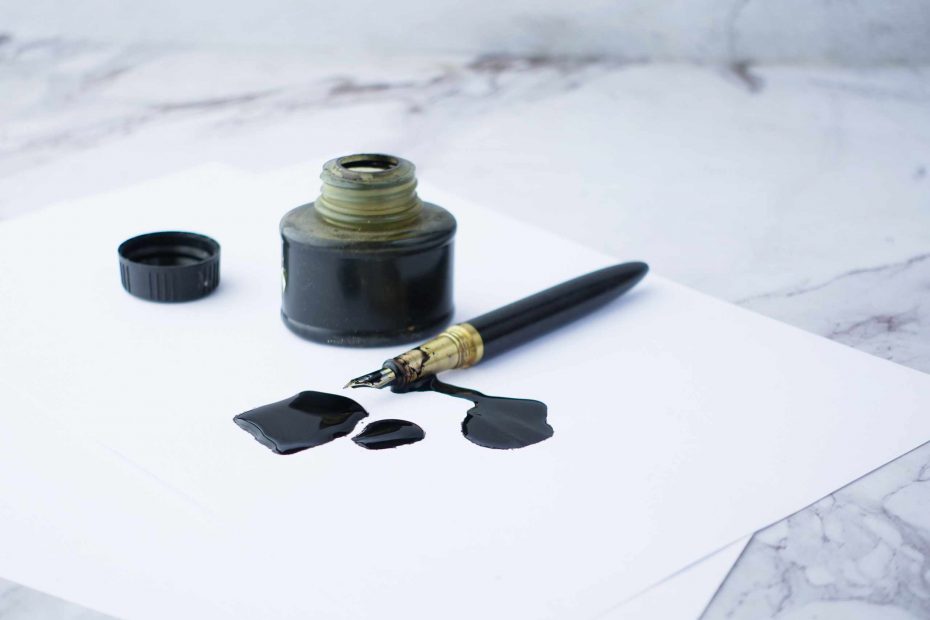
Try holding your pen at a specific angle, drawing a downstroke slowly, then turn the pen slightly and draw the same stroke again. You will feel the difference. The line may feel heavier or thinner, scratchy or unsteady, even though your hand may have moved in the same direction. This shows that pen angle is a critical factor in calligraphy and affects how a line is perceived. It explains why a letter may look calm and even instead of appearing inconsistent.
The pen angle affects how you hold the writing instrument. With a brush pen, the angle determines the contact between the paper and the soft, flexible tip. For a pointed nib pen, the angle affects how the nib touches the paper, how the ink flows from it, and whether the nib moves smoothly or scrapes. If the pen angle changes while the same letter is being written, the weight of the stroke may look different, which is often puzzling to calligraphers. For example, a downstroke may look strong at the top, weak in the middle, and heavy again at the bottom.
This is why you need to work on your pen angle and pressure separately at first. Pressing harder is not always the answer when a line looks too thin. Sometimes the pen is simply turned away from the direction of movement. If the line is scratchy, the paper might be too textured, but the nib angle might also be causing the tool to scrape instead of glide.
To improve on the angle, you can draw downstrokes and check whether the pen position is stable as you draw. You do not need to write letters yet. Just choose a comfortable angle, hold the pen to the guideline, and then draw one downstroke towards the baseline. Repeat the process at least five or six times and observe the strokes closely. If the strokes look smooth and others look twisted, you should try repeating the row with less wrist tension and a lighter grip.
Your pen angle is also reflected in how you hold the upstrokes, which requires a little lighter pressure and is affected by a tense hand and angle position. When you feel the pressure is too strong, a light upstroke should not feel like dragging a dry branch across the page. You need to find the light pressure that creates a small line when the upstroke feels stable and easy to move. You can use soft practice paper to find the right pressure and angle for these upstrokes.
If the pen angle position is off, the pen may move differently than it would on the same entry stroke and exit stroke. The connection may become pinched if the angle flips or twists. You can check this problem with your own practice. You need to find a smooth entry stroke into the downstroke with a consistent weight, but this is not the same for the entry and exit strokes. The entry and exit strokes are affected by how much pressure you need and the angle you hold the nib when you enter or exit a letter. You can control the movement when you connect entry and exit strokes to the next letter by slowing down the movement and keeping the angle consistent.
To identify if the pen angle is a problem, you can check for repeated problems. One mark on the page may look different due to different reasons, but if your ovals look a little lighter on one side or your loops show the same scratches at the end, it is a sign that the pen angle needs to be checked. Look for a position that you know you did perfectly and keep your pen in that position and continue to repeat that. By identifying the problem, the letter will become easier to write and feel lighter. This helps you move on to writing letters. Calligraphy becomes easier to understand when line weight is explained. The pen should no longer be seen as a fancy tool. Instead, it feels like a tool that is easy to move with a stable contact, constant pressure, and an even pen angle.